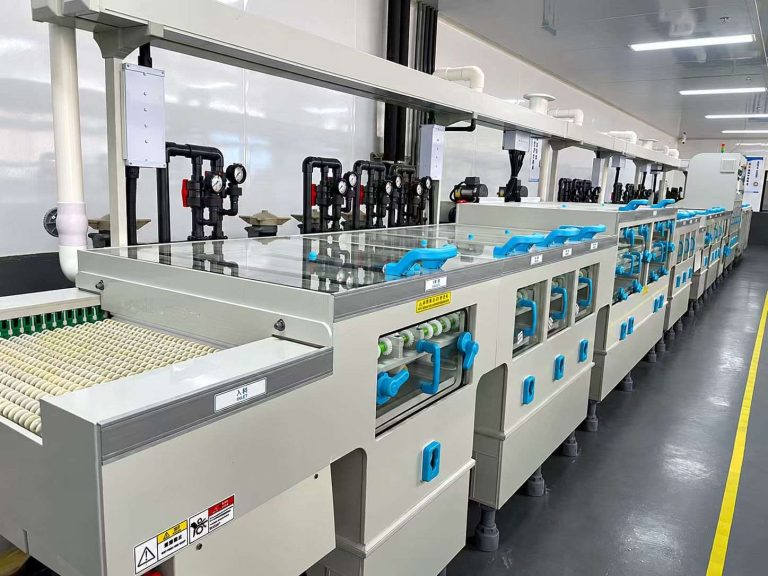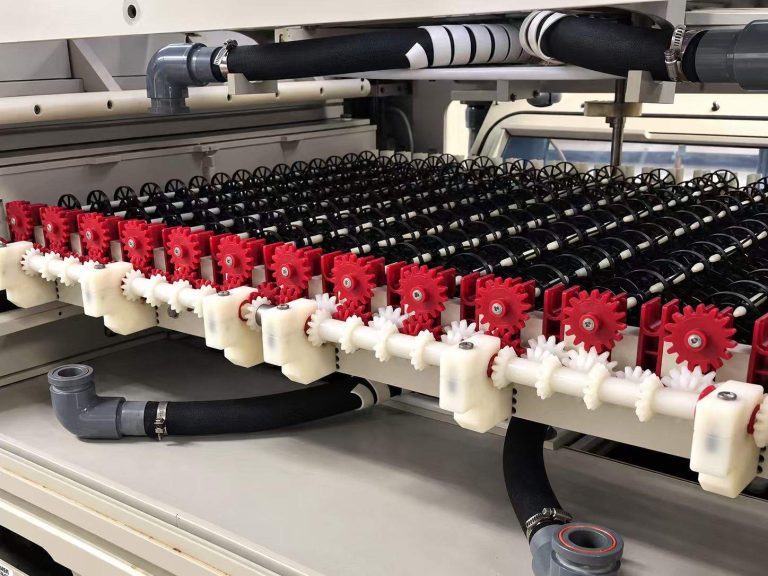
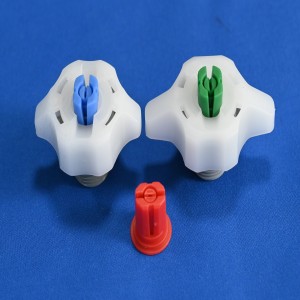
In PCB developing and etching equipment, nozzles are small parts with a direct effect on yield, chemical cost, and maintenance time. When spray nozzle flow rate is too high, a line may waste developer, etchant, or rinse water. When it is too low, panels may leave the chamber with residue, slow reaction, or uneven copper removal. Spray angle matters because it decides how liquid reaches the panel surface. For buyers and process teams, nozzle flow rate and spray angle should be checked before replacing larger modules or changing process chemistry.
Why Nozzle Flow Rate Matters
A nozzle sets more than the amount of liquid leaving a pipe. It also affects impact, droplet behavior, spray balance, and chemical renewal on the PCB surface. In developing equipment, stable flow helps remove soluble photoresist from fine spaces. In etching equipment, fresh etchant must reach copper again and again while spent solution moves away.
Signs of poor flow balance
A repeated line on one side of the panel is often treated as a chemistry issue. Yet if the mark stays in the same spray lane, nozzle blockage, nozzle wear, spray pipe balance, or pressure variation should be checked first. Collecting spray from several nozzles for 60 seconds can quickly show whether one position is far from the group.
| Flow Rate Condition | Common Sign | Possible Result |
| Too low | Weak spray, dry-looking spots | Residue, slow developing, under-etching |
| Too high | Splash, mist, fast chemical loss | Waste, pooling, unstable etching |
| Uneven between nozzles | Repeated streaks or side bands | Local over-etching or under-etching |
| Changed after long use | Higher flow at same pressure | Worn nozzle or enlarged orifice |
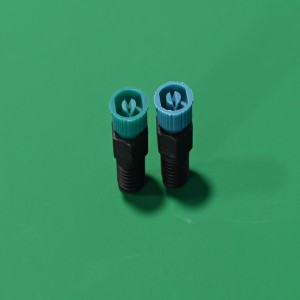
Qixingyuan supplies nozzle cores, wide-angle nozzle cores, PVC nozzle pipes, PP nozzle pipes, pipe caps, plugs, and joints for PCB developing and etching chambers. Buyers can send photos, dimensions, chamber position, liquid type, working pressure, and old samples for a clearer replacement plan.
Why Spray Angle Controls Coverage
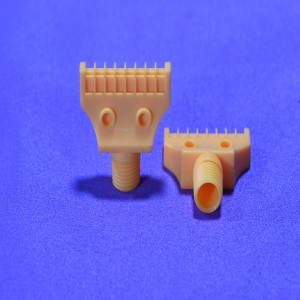
Spray angle decides how wide the liquid fan or cone becomes before reaching the PCB. Real coverage is not only the catalog angle. It also depends on nozzle height, liquid pressure, surface distance, pipe position, and overlap between adjacent sprays.
Nozzle height and overlap
If the nozzle is too close, coverage may be narrow and harsh. If it is too far, droplets can lose impact before reaching the board. When nozzles are spaced too widely, dead zones appear. When they overlap too much, some areas receive more liquid than planned.
Key layout checks include:
- nozzle height from the PCB surface
- distance between adjacent nozzles
- spray angle and spray width
- pipe alignment and nozzle direction
- panel width and conveyor speed
- pressure balance across the chamber
Qixingyuan provides nozzles, nozzle pipes, and joints that help maintenance teams rebuild spray sections instead of replacing a whole chamber. Matched spray accessories can reduce trial fitting during shutdown and make spare stock easier to manage.
Choose Flow Rate and Spray Angle Together
A common mistake is to treat flow rate and spray angle as separate choices. In real equipment, they work as one spray system. A nozzle with the same spray angle but a different flow rate may change droplet size and impact. A nozzle with the same flow rate but a wider spray angle spreads the same liquid across a larger area, lowering impact at each point.
What procurement teams should confirm
Before buying replacement nozzles for PCB developing equipment or PCB etching equipment, check the process stage, working pressure, spray angle, nozzle material, pipe connection, thread size, and cleaning access. Also confirm whether the liquid is developer, etchant, cleaner, rinse water, or another chemical mixture. A part that fits the pipe but fails in the chemical zone is still the wrong part.
Qixingyuan can help buyers source nozzles together with spray pipes, joints, cleaning products, filters, pressure gauges, and flow meters. This is practical when a factory wants one supplier to review connected wet process spare parts instead of buying each small item separately.
Common Problems and Maintenance Checks
When nozzle selection is wrong, the effect usually appears as a process issue. Operators may see poor image clarity after developing, copper residue after etching, streaks after rinsing, or repeated stains after cleaning. The root cause may be a blocked nozzle, worn orifice, wrong spray angle, low pressure, poor pipe alignment, or mismatched spare parts.
A simple inspection path
Before changing chemistry, compare defect locations on three to five panels. Check whether the mark stays in the same spray lane. Inspect nozzles for clogging, cracks, wear, or chemical buildup. Read pressure gauges and flow meters. Confirm conveyor speed and panel tracking. Review spray pipes, caps, plugs, and joints.
For lines running daily, a short monthly nozzle review is often better than waiting for visible defects. Maintenance teams can remove sample nozzles from high-duty positions, check the orifice, clean deposits with a safe method, and compare spray output.
Produto de Qixingyuan range also covers conveyor rollers, wheel discs, gears, bushings, air knives, water retaining rollers, and measurement products. This matters because etching uniformity is not controlled by nozzles alone. Board movement, spray balance, drying, and transmission stability must work together.
Shenzhen Qixingyuan Machinery Equipment Co., Ltd.
Shenzhen Qixingyuan Machinery Equipment Co., Ltd. is a PCB horizontal line wet processing equipment spares and parts supplier based in Shenzhen, China. The company serves factories that use developing, etching, cleaning, rinsing, drying, conveying, and related wet process lines. Its product scope includes nozzles, nozzle pipes and joints, spray and cleaning products, air knives, water retaining rollers, conveyor rollers and wheel discs, gears and screws, transmission system parts, bushings, consumables, and measurement and control products.
For B2B buyers, the main value is application-based part matching. Many PCB lines include older equipment, modified chambers, or mixed spare parts. Qixingyuan can review drawings, samples, photos, materials, chemical exposure, temperature, line speed, and installation position. This helps maintenance and purchasing teams order parts that fit the real machine rather than relying only on general catalog descriptions.
Conclusão
Nozzle flow rate and spray angle are not minor details in PCB developing and etching equipment. They affect spray coverage, chemical distribution, impact force, etching uniformity, residue removal, rinsing quality, and chemical cost. The best choice is not always a larger flow rate or wider spray angle. It is the nozzle that matches pressure, pipe layout, panel distance, process stage, material needs, and maintenance plans.
For factories planning nozzle replacement, the safest path is to check the defect pattern, measure spray output, inspect pipe condition, and review related conveyor and pressure parts. Qixingyuan can support this work with PCB wet process equipment spare parts for spray, cleaning, conveying, drying, and measurement sections.