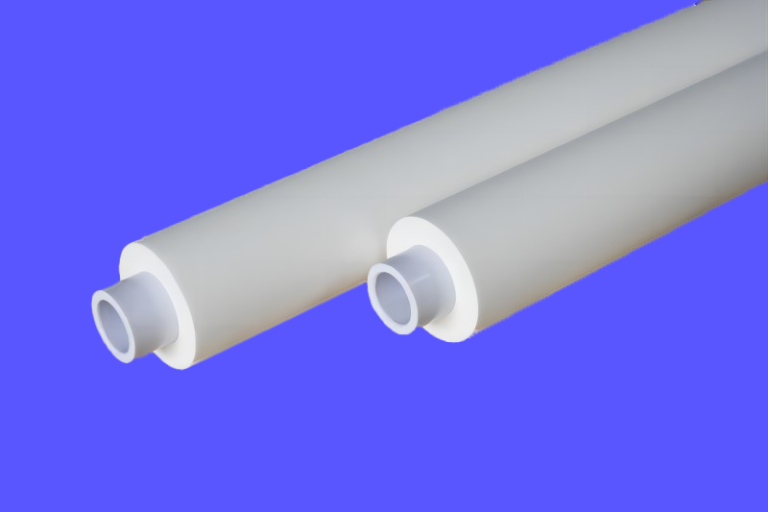
PP Sponge roller for water-absorption and wiping positions after PCB cleaning or before hot-air drying. PP + PVC pipe and heat resistance, acid and alkali resistance, wear resistance and liquid cutting.
Ưu điểm cốt lõi: Strong water absorption, soft and non-shedding, long service life.
Significant Advantages: Quickly removes residual water, improves drying efficiency, reduces energy consumption, and ensures smoother post-processing.
The PP sponge roller removes residual water and wipes PCB surfaces after cleaning or before hot-air drying. Its non-swelling characteristic helps maintain the working diameter during the intended water-removal duty, supporting consistent contact as boards pass through the roller position.
The roller uses a PP and PVC pipe construction and is resistant to weak acids and alkalis. Custom dimensions are available to suit the installation. Diameter and density should be selected with reference to line speed, roller spacing, and the process liquid.
| Item | Specification |
| Product Name | con lăn xốp PP |
| Vật liệu | PP + PVC pipe |
| Primary Function | Water absorption and surface wiping |
| Swelling Behavior | Non-swelling |
| Khả năng kháng hóa chất | Resistant to weak acids and alkalis |
| Process Position | After PCB cleaning or before hot-air drying |
| Size | Customizable |
| Diameter and Density | Selected to suit line speed and roller spacing |
– Non-swelling behavior helps retain the roller’s intended working diameter during suitable liquid-contact service. This supports the contact setting established during installation.
– Resistance to weak acids and alkalis provides a defined chemical suitability characteristic for equipment selection. Confirm the actual formulation, concentration, temperature, and exposure duration.
– An absorbent working surface takes up residual water from the board at the contact position, assisting preparation for the following process.
– The wiping function helps remove surface water as boards move through the roller assembly. Alignment and contact pressure affect how evenly the roller works across the board width.
– Wear resistance supports repeated contact in water-removal duty. Regular inspection is still needed to identify surface damage or deterioration in performance.
– Custom dimensions and diameter/density selection help match the roller to the working width, line speed, and available roller spacing.
Water carried from a cleaning stage can remain on the PCB as it approaches the next module. The sponge roller provides a contact surface that takes up and wipes away some of this water. In a suitable line layout, this reduces the residual water reaching the hot-air drying section.
The water-removal result depends on incoming water load, board speed, roller condition, and contact across the working width. A properly matched roller supports this process, while the downstream drying equipment determines the final drying result together with the rest of the line.
– Residual-water removal after PCB cleaning
– Surface wiping before hot-air drying
– Wet-process roller positions with compatible weak acid or alkali exposure
– Replacement of matched sponge rollers in existing PCB equipment
– Customized absorbent roller assemblies for cleaning and drying lines
Swelling can change a roller’s effective diameter and contact with the board or mating roller. The PP sponge roller’s non-swelling characteristic is useful where that working geometry needs to remain consistent during liquid exposure. Correct installation dimensions are still necessary to establish the initial contact.
Non-swelling behavior does not establish resistance to every form of wear, compression, heat, or chemical attack. Review those operating conditions separately. The confirmed chemical-resistance scope is weak acids and alkalis; identify the actual solution instead of selecting the roller from a general acid-resistant label alone.
Roller size can be customized to the equipment. Provide the outside diameter, working-face length, overall length, PVC pipe dimensions, and shaft or bore arrangement. Include mounting details and the position of neighboring rollers so the assembly can be checked against the available space.
Diameter and density selection should consider line speed, roller spacing, board thickness, and the liquid reaching the roller. Submit a drawing, sample, or photographs of the existing assembly. Confirm the final construction and dimensional requirements before production.
Confirm the process liquid and exposure conditions before reviewing the mechanical fit. State the chemical formulation, concentration, working temperature, and contact duration. Resistance to weak acids and alkalis should not be used as approval for strong or concentrated processing solutions.
Then check the roller diameter, working width, spacing, board speed, and required contact. Excessive pressure can affect both board handling and the sponge surface. For a heated process position, confirm the permitted operating temperature for the complete assembly before ordering.
Obtain the commissioning and cleaning instructions for the supplied configuration. Check that the existing supports and drive arrangement are in suitable condition; replacing the sponge roller alone will not correct a misaligned or damaged mounting system.
– Isolate the machine according to its maintenance procedure before removing or installing the roller.
– Verify the outside diameter, working length, pipe dimensions, and mounting arrangement against the approved drawing or sample.
– Prepare the supplied roller according to its commissioning instructions before starting production.
– Keep the working surface and mounting points free from grit, sharp debris, and process deposits.
– Check free rotation, alignment, and clearances, then set contact using the equipment manufacturer’s procedure.
– Inspect for tears, uneven wear, deposits, loose mounting parts, or a change in water-removal performance.
– Use a cleaning method confirmed for the roller and the actual process chemistry. Avoid introducing an unapproved cleaner during maintenance.
– If water removal becomes uneven, review roller contact, surface contamination, incoming water load, and the condition of adjacent components before replacing parts.
Agree the dimensions, selected density, pipe and mounting details, and working-surface requirements on a drawing or confirmed sample. Include the intended process liquid and operating conditions in the order specification so chemical suitability can be reviewed with the mechanical design.
Qixingyuan Machinery supplies accessories for PCB processing equipment. Send the existing roller drawing, installation photographs, and application details to discuss a replacement or customized size. Clear technical information helps identify the assembly required for the line.
Confirm packaging that protects the sponge surface and projecting components from contamination, sharp contact, and concentrated pressure. Discuss storage instructions, packed dimensions, order quantity, destination, and delivery requirements when requesting the quotation.
– Equipment model and intended water-removal or wiping position
– Outside diameter, working-face length, and overall length
– PVC pipe dimensions and shaft or bore arrangement
– Drawing, sample, or photographs of the roller and mounting points
– Line speed, roller spacing, and board thickness
– Process liquid, chemical concentration, working temperature, and exposure duration
– Incoming water load and required density where already specified
– Quantity, delivery destination, and requested delivery date
What is the PP sponge roller used for?
It is used for water absorption and surface wiping after PCB cleaning or before hot-air drying, with the configuration matched to the equipment and process liquid.
Does the roller swell during use?
The roller is non-swelling in its intended application. This characteristic helps maintain its working diameter during suitable liquid exposure. Contact pressure, wear, and chemical suitability still need separate attention.
Is it resistant to acids and alkalis?
It is resistant to weak acids and alkalis. Provide the actual chemical formulation, concentration, temperature, and exposure duration for suitability review.
Can the roller size be customized?
Yes. Provide the outside diameter, working length, overall length, pipe dimensions, and mounting details. A drawing or sample helps confirm the required size.
How are diameter and density selected?
Selection considers line speed, roller spacing, board contact, and the process liquid. Supply these conditions with the installation dimensions when requesting a quotation.
Can the roller replace the drying section?
Its role is to absorb and wipe residual surface water. The final drying requirement should be assessed using the incoming water load, roller contact, and downstream drying arrangement.
Cung cấp các phụ kiện thiết bị PCB có độ chính xác cao, hiệu suất cao, giúp ngành công nghiệp sản xuất điện tử toàn cầu đạt được hiệu quả sản xuất cao.